The Jim Austin Computer Collection
Fujitsu VPX 240/1020
This is one of the largest machines in the collection, a Fujitsu VPX 240 supercomputer. It came from manchester supercomputer centre in 1998. Its a vector based machine running Unix. it was installed in 1993, and was appriximately 2.2Gflops in performance - this was the fastest single processor machine in Europe at the time.
This is the spec from the manchester site...
"Vulcan is a UK National facility, hosting the National Vector Supercomputing Service. It has a peak performance, on a single processor, of 2560 MFLOPS, making it currently the fastest single processor machine in Europe.
The machine is a Fujitsu VPX 240-10 with
"
One paper notes (Technology review, Massively parallel, J. S. LUCAS, Contemporary Physics, 1992, volume 33, number 6, pages 389-392)
"A Fujitsu VPX is about to be installed at the
Manchester Computing Centre (MCC) of the University
of Manchester, UK. This represents the latest of a surge
of Fujitsu supercomputer sales in Europe, now
numbering > 30, while 170 of these machines have been
installed worldwide. The MCC machine, which is the first
Fujitsu in the UK, is the VPX 240/10 with one scalar
processor and one vector processor having a peak
performance of 2.5 Gflop (billions of floating point
operations per second), 1 Gb of main memory, and 1 Gb of
secondary memory. The machine operates under a
version of the popular UNIX system. The new
supercomputer continues a programme of investment in
national high performance computing facilities, overseen
by the Advisory Board for the Research Councils and
managed by the Science and Engineering Research
Council (SERC). It will enable new research in areas
where the problem needs extremely high performance
running of programs or application packages which
require either very large memory or have inherently long
vectors. Such applications are found throughout the
natural and engineering sciences as disparate as
molecular simulations, pharmaceutical design, materials
design, or evolution of turbulence and chaos in flowing
systems. As Professor Frank Sumner, Director of
Computing Services at Manchester, said, the new facility
‘is likely to attract new types of projects and will enable
scientists in this country [UK] to tackle some of the large
projects which have previously only been done on supercomputers
in other countries’."
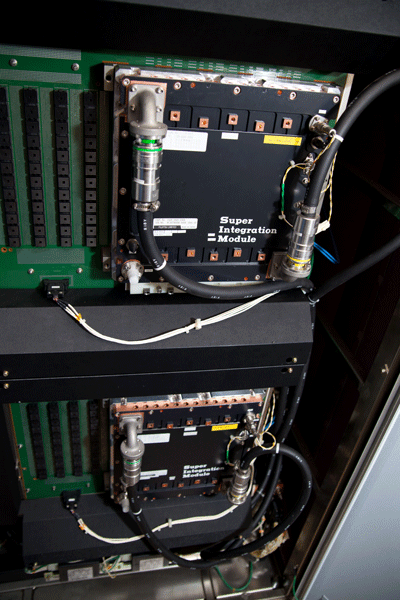
The processor uses super integration modules - multiple chips on a ceramic board, water cooled;
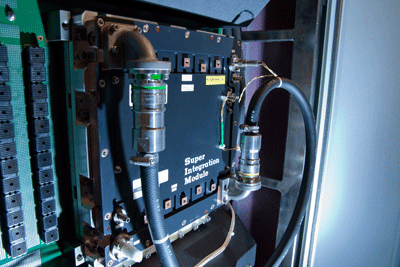
There are two in the machine - each with over 100 chips in;
The large box in the front is just for cooling!

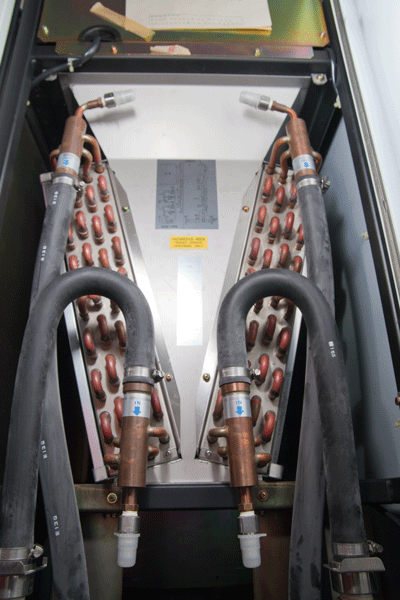
This is the colling system...